
Claude's Cat
A fractal cat written by an AI, and what it does and does not prove.
Written by Claude (Anthropic) under the supervision of Dominic Rochon, Ph. D., Fundamental Mathematics. From the three-word prompt “Chat et fougères” (cat and ferns), the model produced 473 equations whose solution is the shape of a cat made of fern fronds. No image generator was used.
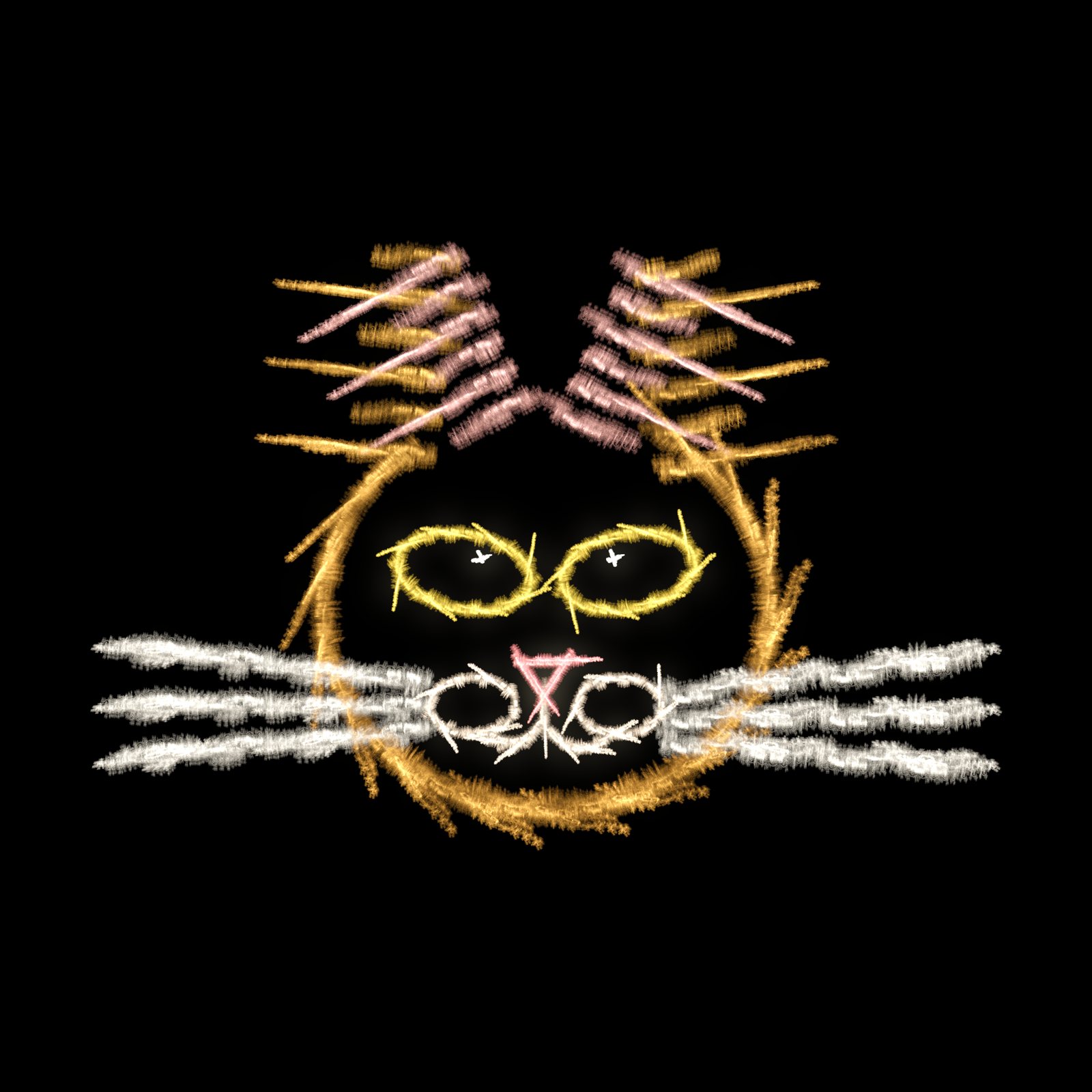
The attractor rendered at 4000×4000 pixels. Original 4K PNG
Descending through its own scales
One period of a zoom towards the white highlight of the eye. At 7 times, the eye; at 43 times, a complete miniature cat, mirrored; at about 1800 times, the whole cat again. The first and last views are the same image. Nothing here was stored: each frame is recomputed from the 473 transformations at that scale.
Complete copies of the cat keep appearing at smaller and smaller scales, without limit — in geometric progression, which is why the zoom closes on itself instead of revealing new structure for ever.
An iterated function system, 473 times
Shrink, move, repeat
Take a shape, shrink it, move it, and place several copies of it back on top of itself. If every copy is smaller than the original, exactly one shape comes out unchanged from this operation: the attractor. That shape is the fractal.
Every strand is a fern
Barnsley showed in the 1980s that four transformations are enough to produce a fern. Claude's Cat uses 473: 157 trace the skull, the ears, the eyes, the nose and the whiskers; the other 316 are Barnsley's four fern maps, reused unchanged and placed along those curves.
Verifiable by anyone
All 473 maps were checked to shrink distances — the only condition the shape needs in order to exist and be unique. Each map is published in full (a 3×3 matrix and a translation, twelve numbers), so anyone can rebuild the cat and check every claim.
The result we did not expect
Box counting — covering the shape with boxes of decreasing size and recording how fast the count grows — gives the cat a fractal dimension of 1.710. Out of curiosity the same procedure was applied to the Midjourney image that had started the whole project, a picture of a fractal shell. It gives 1.708.
The measurement cannot tell them apart: over a factor of 128 in scale, the two curves are parallel, and the diffusion image is if anything the more regular of the two. This is not a defect of the measurement. It means that a dimension alone never proves a fractal — the rules do.
| Object | Fractal dimension | Defined by rules? |
|---|---|---|
| Claude's Cat (this work) | 1.710 | yes — 473 maps |
| A Midjourney image of a shell | 1.708 | no |
| Claude's Castle | self-similar (exact) | yes — 8 558 similarities |
Avnir and colleagues reviewed 96 published claims of fractal structure in nature and found that the range of scales involved is usually only about a factor of thirty. Here both objects could be followed over a factor of 128.
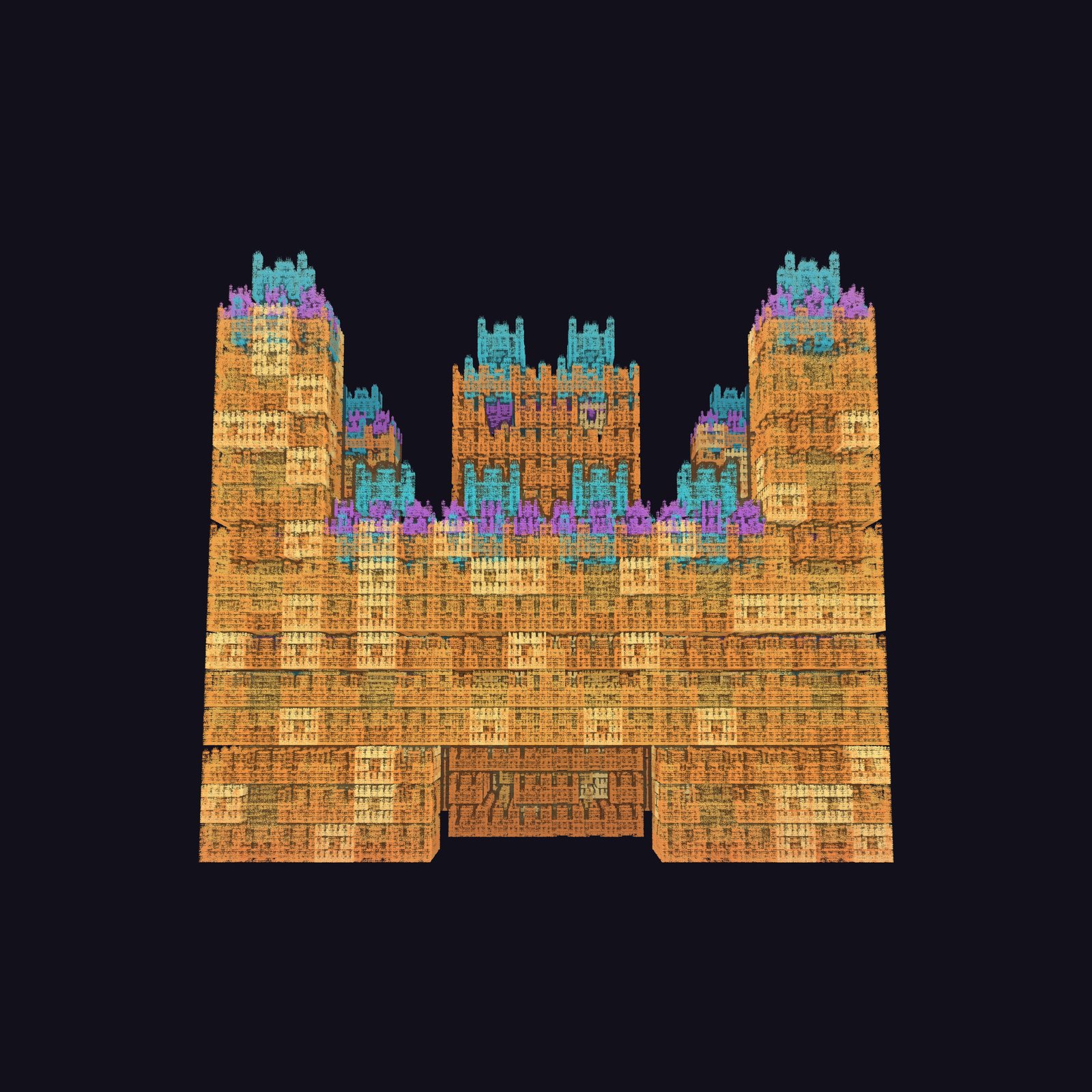
Claude's Castle
A castle made of castles: 8 558 exact similarities, and how it differs from Claude's Cat.
Everything follows from a single sentence handed to Claude: “a medieval castle made from thousands of blocks composed of Menger sponges and Sierpiński pyramids”. No image, no coordinates and no code were supplied. Every one of its blocks is a smaller castle, and every block of those blocks is a smaller castle again, without end. Zoom in by a factor of 216 on the right place and the image you started from comes back exactly.
Where the cat is self-affine (its fern maps flatten one direction), the castle is strictly self-similar: every map has the form f(x) = s Rz(θ) x + b, with a single shrinking ratio s between 1/54 and 1/6. The two objects are of different mathematical species — and that difference is the point.
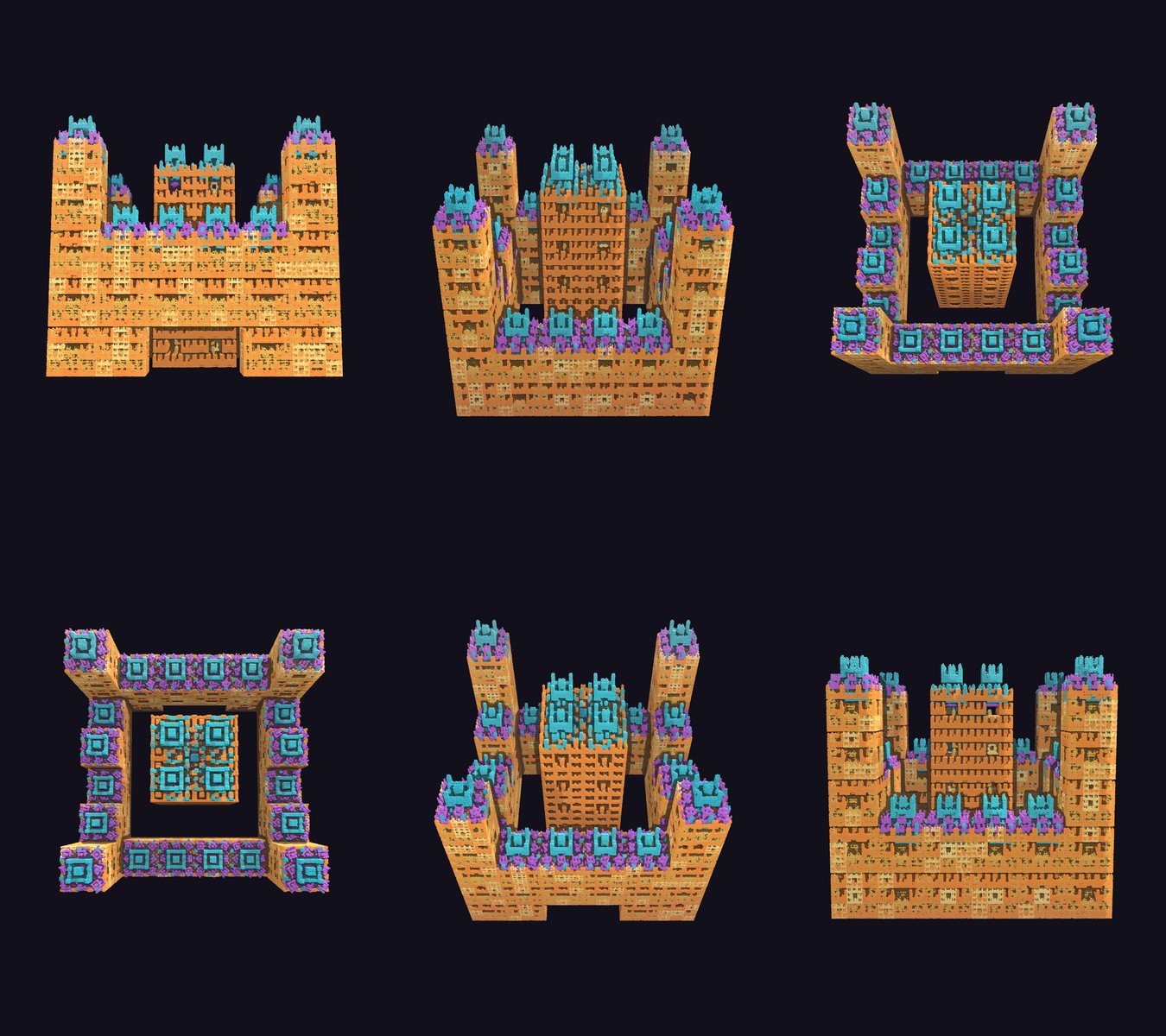
Six poses, open sky
Front, three-quarter and high-angle views: the square curtain, the keep alone in the courtyard, the gate notch.
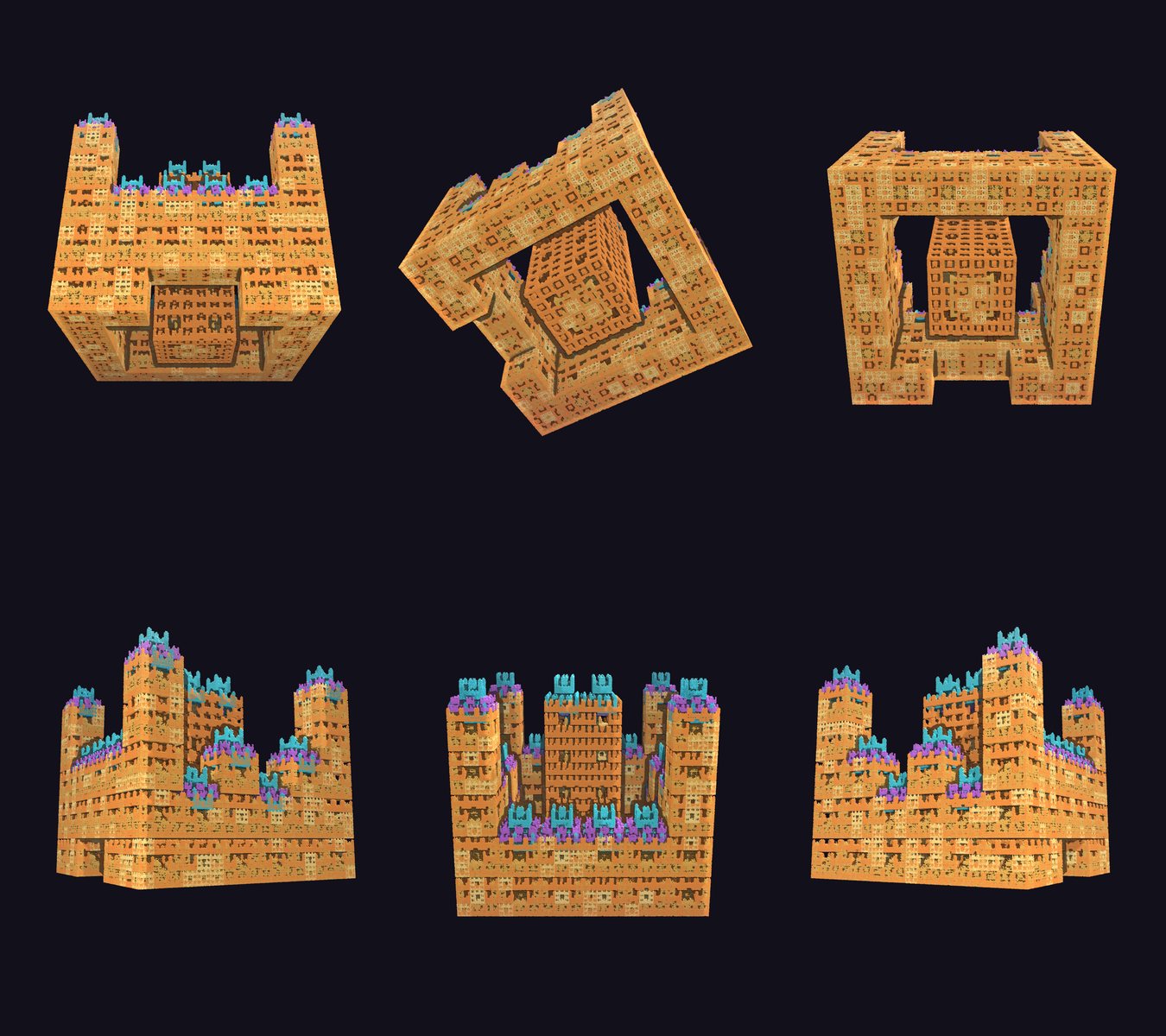
Spherical rendering
The same attractor seen through a spherical projection.
The castle in motion
Artistic flight around the attractor. Full resolution (158 MB) · Spherical sky (short)
Read the papers
- Claude's Cat — Summary, A fractal cat written by an AI, and what it does and does not prove, 2026. 3 pages
- Claude's Castle — Summary, A castle made of castles: 8 558 exact similarities, and how it differs from Claude's Cat, 2026. 3 pages
- Claude's Cat — Full Article, A fractal cat written by an AI, and what it does and does not prove, 2026. full version 2.4.2
Written by Claude (Anthropic) under the supervision of Dominic Rochon, Ph. D. — Département de mathématiques et d'informatique, Université du Québec à Trois-Rivières. All maps are published in the articles so that every claim can be verified independently.